
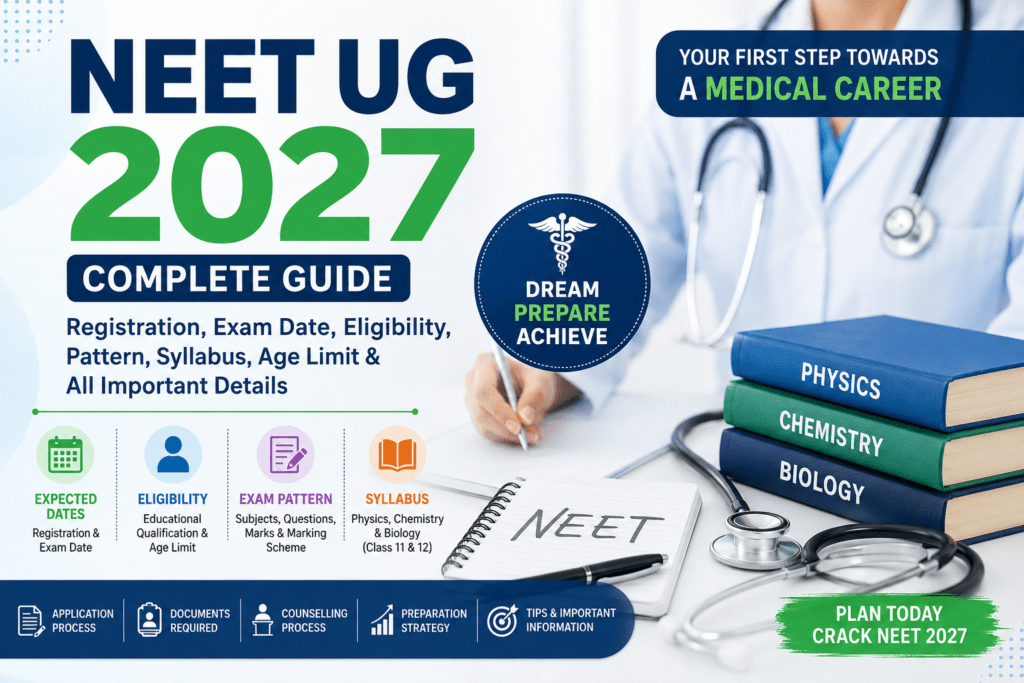
Are you dreaming of becoming a doctor? If MBBS, BDS, or any other medical course is on your mind, then NEET UG 2027 is probably the biggest milestone waiting for you. Every year, over 15 lakh students appear for this single national-level entrance exam, making it one of the most competitive exams in India. And honestly? The competition is only getting tougher.
But here’s the thing – success in NEET isn’t just about studying hard. It’s also about knowing the right information at the right time. Exam dates, syllabus changes, eligibility criteria – miss any of these, and your entire year of preparation could go down the drain.
So, let’s cut through all the confusion and speculation. Here’s everything you need to know about NEET UG 2027 – from registration dates to exam pattern, syllabus, eligibility, and more. All in plain, simple language. No jargon. No fluff.
NEET UG 2027 at a Glance
Before we dive deep, here’s a quick snapshot:
| Particulars | Details |
|---|---|
| Exam Name | National Eligibility cum Entrance Test (NEET) UG |
| Conducting Body | National Testing Agency (NTA) |
| Exam Frequency | Once a year |
| Purpose | Admission to MBBS, BDS, BAMS, BHMS, BUMS, B.Sc Nursing, BVSc & AH courses |
| Total Marks | 720 |
| Marking Scheme | +4 for correct answer, -1 for incorrect |
| Languages | 13 languages including Hindi, English, Tamil, Telugu, and more |
NEET UG 2027 Important Dates (Tentative)
Let’s be honest – the official notification for NEET 2027 hasn’t been released yet. NTA will publish the confirmed schedule on their official website neet.nta.nic.in. But based on previous years’ patterns, here’s what the timeline is expected to look like:
A quick word of advice: Don’t wait until the last day to fill your application form. The website crashes, payment gateways fail, and stress levels hit the roof. Just don’t do it to yourself.
Who Can Apply for NEET UG 2027? (Eligibility Criteria)
The eligibility criteria for NEET 2027 are pretty straightforward. But you need to check every single condition carefully before filling out that application form. Here’s what you need:
1. Educational Qualification
You must have passed Class 12 (10+2) or be appearing for it in 2027
Your subjects must include Physics, Chemistry, and Biology/Biotechnology along with English
Minimum aggregate marks in PCB (Physics, Chemistry, Biology/Biotechnology):
2. Age Limit
Minimum Age: You must be at least 17 years old as of December 31, 2027
Upper Age Limit: As per current rules, there is no upper age limit for appearing in NEET
But here’s a pro tip: Always double-check this in the official information bulletin when it releases. Age limit rules have been debated in courts before, so it’s better to be sure.
3. Nationality
The following candidates are eligible:
Indian Nationals
Non-Resident Indians (NRIs)
Overseas Citizens of India (OCIs)
Persons of Indian Origin (PIOs)
4. Number of Attempts
Currently, there’s no limit on the number of attempts for NEET. You can appear as many times as you want, as long as you meet the age and educational criteria. But again – confirm this in the 2027 bulletin when it’s out.
NEET UG 2027 Exam Pattern – What’s Changing?
Alright, this is where things get interesting. Big news: NEET UG is going COMPUTER-BASED from 2027.
Yes, you read that right. After years of the traditional pen-and-paper OMR format, NTA has announced that NEET 2027 will be conducted entirely in Computer-Based Test (CBT) mode. This decision came after concerns about paper leaks and irregularities in previous years.
What Does This Mean for You?
Instead of filling bubbles on an OMR sheet, you’ll be answering questions on a computer at your exam centre. Think of it like how JEE Main is already conducted.
Here’s what the new CBT format will likely look like:
On-screen timer showing your remaining time
Colour-coded question palette showing which questions you’ve answered, not answered, or marked for review
“Save & Next” and “Mark for Review” buttons for easy navigation
A final review-and-submit screen before the exam ends
A physical rough sheet will still be provided for calculations (because let’s face it – you can’t do Physics sums in your head)
Exam Pattern Details
Despite the shift to CBT, the core exam pattern is expected to remain the same:
| Subject | Total Questions | Marks |
|---|---|---|
| Physics | 45 | 180 |
| Chemistry | 45 | 180 |
| Botany | 45 | 180 |
| Zoology | 45 | 180 |
| Total | 180 | 720 |
Marking Scheme:
Exam Duration: 3 hours (180 minutes)
Pro tip: The exam might be conducted over multiple days and in multiple shifts to accommodate the huge number of candidates (over 22 lakh students appear every year!). A percentile-based normalisation process is expected to ensure fairness across different shifts.
NEET UG 2027 Syllabus – What to Study?
Good news – the NEET syllabus is not expected to change significantly for 2027. It will continue to be based on the NCERT Class 11 and Class 12 syllabus, as prescribed by the National Medical Commission (NMC).
Subject-Wise Breakdown
Biology (Botany + Zoology) – 360 marks (50% weightage)
This is your high-scoring section. Biology alone carries half the marks, so give it the attention it deserves.
Physics – 180 marks (25% weightage)
Chemistry – 180 marks (25% weightage)
Chapter-Wise Weightage (Based on NEET 2023-25 Trends)
Physics – High Priority Chapters:
Chemistry – High Priority Chapters:
Biology – High Priority Chapters:
Important: Always refer to the official NMC/NTA syllabus PDF when it’s released. Don’t skip entire chapters based on third-party lists – only skip specific sub-topics that are officially deleted.
How to Apply for NEET UG 2027?
The application process is entirely online. Here’s how it works:
Register with your basic details (name, email, phone number)
Fill out the application form with your personal, educational, and contact details
Upload documents – passport-size photo, signature, and other required documents
Pay the application fee online (the exact fee will be confirmed in the official notification)
Submit and download the confirmation page for your records
Remember: Applications are accepted ONLY online through the official NTA website. Don’t fall for any offline application scams.
NEET UG 2027 – Key Changes to Know
Here’s a quick summary of what’s new for NEET 2027:
Preparation Tips for NEET UG 2027
1. Adapt to the CBT Format
Since this is a major change, start practicing on computers. Take online mock tests regularly. Get comfortable with on-screen navigation, timers, and the “Mark for Review” feature.
2. Master NCERT First
Your syllabus is NCERT-based. Don’t run after multiple reference books before you’ve mastered your NCERT textbooks. Seriously – NCERT first, everything else later.
3. Focus on Biology
Biology carries 360 marks – that’s half your total score. If you’re strong in Biology, you’re already ahead of the game.
4. Practice Previous Year Papers
Even though the exam mode is changing, the question types and difficulty level are expected to remain similar. Solve NEET previous year papers to understand the pattern.
5. Time Management is Key
You have 180 minutes for 180 questions. That’s one minute per question. Practice speed and accuracy together.
6. Mock Tests, Mock Tests, Mock Tests
Take at least one full-length mock test every week. Simulate exam conditions – no distractions, strict timing, and no cheating.
Frequently Asked Questions
Q: When will the official NEET 2027 notification be released?
A: The official notification is expected in February 2027. NTA hasn’t confirmed the exact date yet.
Q: Is NEET 2027 going to be online?
A: Yes. NEET UG 2027 will be conducted in Computer-Based Test (CBT) mode.
Q: What is the age limit for NEET 2027?
A: You must be at least 17 years old by December 31, 2027. There’s currently no upper age limit.
Q: Can I appear for NEET 2027 if I’m appearing for Class 12 in 2027?
A: Yes, candidates appearing for their Class 12 board exams in 2027 are eligible to apply.
Q: How many questions are there in NEET?
A: There are 180 compulsory questions – 45 each from Physics, Chemistry, Botany, and Zoology.
Q: What is the marking scheme for NEET?
A: +4 marks for correct answers, -1 mark for incorrect answers, and 0 for unattempted questions.
Final Word
NEET UG 2027 is going to be different. The shift to CBT mode is a significant change, but the core of the exam – the syllabus, the marking scheme, and the competition – remains the same.
Don’t let the change scare you. Start preparing early, stay updated with official announcements on neet.nta.nic.in, and most importantly, stay consistent with your studies.
Remember, every year, lakhs of students clear this exam. There’s no reason you can’t be one of them. Stay focused, stay disciplined, and keep your eyes on the prize.
Good luck, future doctor!