
in NEET 2026
Biology
Paper
Chapters
NCERT Only
- Chapter-Wise Weightage Overview
- Class 11 Botany — Important Topics
- Class 11 Zoology — Important Topics
- Class 12 Botany — Important Topics
- Class 12 Zoology — Important Topics
- Top 10 Most Important Biology Chapters
- Never Skip These Topics — Asked Every Year
- Important Diagrams to Master
- NCERT Study Tips for Biology
- Chapter-Wise Preparation Strategy
- Frequently Asked Questions
1. NEET 2026 Biology Chapter-Wise Weightage Overview
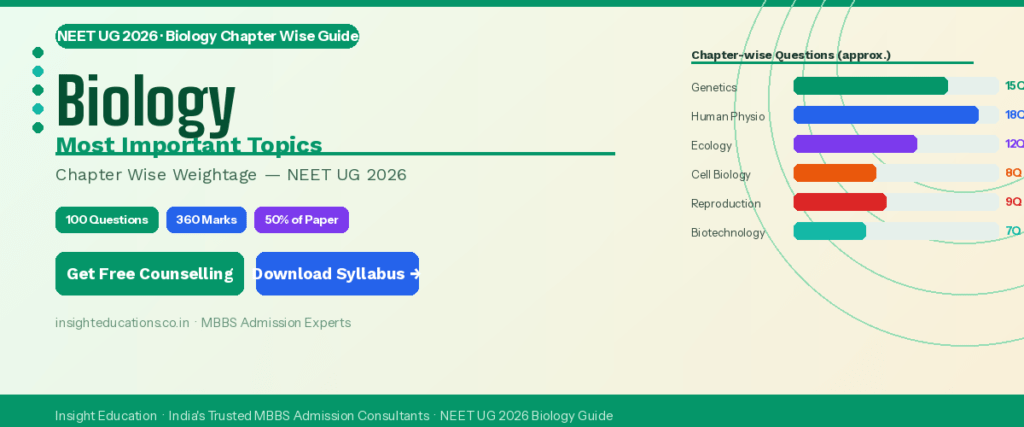
Weightage AnalysisBased on the last 5 years of NEET question papers (2020–2025), here is the approximate number of questions from each major Biology topic group:
Complete Chapter-Wise Weightage Table — NEET 2026 Biology
| Chapter | Class | Avg Questions | Marks | Priority |
|---|---|---|---|---|
| Human Physiology (All chapters) | 11 | 14–18 | 56–72 | Must Do |
| Genetics & Molecular Basis of Inheritance | 12 | 13–16 | 52–64 | Must Do |
| Ecology & Environment | 12 | 10–13 | 40–52 | Must Do |
| Reproduction | 12 | 8–11 | 32–44 | Very High |
| Cell: Structure & Function | 11 | 6–9 | 24–36 | Very High |
| Plant Physiology | 11 | 6–9 | 24–36 | High |
| Biotechnology | 12 | 5–8 | 20–32 | High |
| Human Health & Disease | 12 | 4–7 | 16–28 | High |
| Diversity in Living World | 11 | 4–7 | 16–28 | Medium |
| Structural Organisation (Plants + Animals) | 11 | 3–5 | 12–20 | Medium |
| Biomolecules | 11 | 3–5 | 12–20 | Medium |
| Biological Classification | 11 | 2–4 | 8–16 | Medium |
| Microbes in Human Welfare | 12 | 2–4 | 8–16 | Low-Medium |
| Strategies for Enhancement in Food Production | 12 | 2–3 | 8–12 | Low-Medium |
| Environmental Issues | 12 | 1–3 | 4–12 | Low |
2. Class 11 Botany — Important Topics & Key Points
Class 11 Botany- Five Kingdom Classification (Whittaker)
- Differences between Kingdoms — Monera, Protista, Fungi, Plantae, Animalia
- Lichens, Mycorrhizae — symbiotic associations
- Viruses — structure, tobacco mosaic virus
- Binomial nomenclature rules (ICBN)
- Plant Kingdom — Algae, Bryophytes, Pteridophytes, Gymnosperms, Angiosperms
- Root, stem, leaf modifications with examples
- Types of inflorescence
- Flower structure — parts and functions
- Placentation types
- Fruit types (simple, aggregate, multiple)
- Families: Fabaceae, Solanaceae, Liliaceae
- Prokaryotic vs Eukaryotic cell differences
- Plasma membrane — fluid mosaic model, osmosis
- Endomembrane system — ER, Golgi, Lysosomes
- Mitochondria and Chloroplast — structure in detail
- Nucleus — nuclear envelope, chromatin
- Cell Wall composition
- Ribosomes — 70S vs 80S
- Cell Division — Mitosis & Meiosis (all stages)
- Carbohydrates — monosaccharides, disaccharides, polysaccharides
- Proteins — amino acids, peptide bonds, protein structure
- Enzymes — properties, cofactors, inhibition, Michaelis-Menten
- Lipids — phospholipids, steroids
- Nucleic acids — DNA vs RNA structure
- Vitamins — types and deficiency diseases
- Water potential — concept and calculation
- Osmosis, plasmolysis, imbibition
- Transpiration types and factors affecting
- Ascent of sap — cohesion-tension theory
- Phloem transport — mass flow hypothesis
- Mineral absorption — active vs passive
- Light reactions — Z-scheme, photosystems PS I & PS II
- Cyclic & non-cyclic photophosphorylation
- Calvin cycle — C3 pathway in detail
- C4 pathway (Hatch & Slack) — Kranz anatomy
- CAM plants — desert adaptations
- Photorespiration and its significance
- Factors affecting photosynthesis
- Glycolysis — complete steps, ATP yield
- Krebs cycle — substrates, products, enzymes
- Oxidative phosphorylation — ETC and ATP synthesis
- Fermentation — alcoholic and lactic acid
- RQ (Respiratory Quotient) values
- Aerobic vs anaerobic respiration comparison
- Phytohormones — Auxin, Gibberellin, Cytokinin, ABA, Ethylene
- Photoperiodism — short day, long day, day-neutral plants
- Vernalisation definition and significance
- Seed dormancy and germination
- Growth regulators and their commercial uses
3. Class 11 Zoology — Important Topics & Key Points
Class 11 Zoology- Digestive system — all organs and their functions
- Enzymes in digestion — where produced, substrate, product
- Small intestine — villi, microvilli, absorption
- Large intestine functions
- Liver — bile production, glycogen storage
- Digestion of carbohydrates, proteins, fats step-by-step
- Human heart — chambers, valves, blood flow path
- Cardiac cycle — systole, diastole, cardiac output
- ECG — P, Q, R, S, T waves meaning
- Blood pressure — systolic/diastolic
- Blood composition — RBC, WBC, platelets
- ABO and Rh blood grouping system
- Lymphatic system basics
- Neuron structure — parts and functions
- Action potential — resting, depolarisation, repolarisation
- Synapse — types and neurotransmitters
- CNS — brain parts and functions
- Reflex arc — steps in detail
- Sense organs — eye and ear structure & function
- Respiratory organs — structure of lungs
- Mechanism of breathing — inspiration & expiration
- Lung volumes — TV, IRV, ERV, RV, FRC, VC, TLC
- Gas exchange — at alveoli and at tissues
- Oxygen transport — oxyhaemoglobin dissociation curve
- CO2 transport — bicarbonate, carbamino-haemoglobin
- Respiratory disorders — asthma, emphysema
- Nephron structure — all parts in detail
- Glomerular filtration — GFR value
- Reabsorption and secretion in nephron
- Counter-current mechanism
- Regulation — ADH, aldosterone, ANF
- Kidney disorders — nephritis, kidney stones
- Dialysis principle
- All endocrine glands — location + hormones
- Hypothalamus — releasing & inhibiting hormones
- Pituitary — anterior and posterior hormones
- Thyroid hormones — T3, T4, calcitonin
- Pancreas — insulin, glucagon functions
- Adrenal gland — cortex vs medulla hormones
- Reproductive hormones — LH, FSH, testosterone, estrogen
4. Class 12 Botany — Important Topics & Key Points
Class 12 Botany- Microsporogenesis — pollen grain development
- Megasporogenesis — embryo sac development
- Pollination types — self and cross pollination
- Pollen-pistil interaction and fertilisation
- Double fertilisation — syngamy + triple fusion
- Endosperm types — nuclear, cellular, helobial
- Embryogenesis — dicot and monocot embryo
- Apomixis and polyembryony
- DNA structure — Watson-Crick model in detail
- DNA replication — enzymes, steps, semi-conservative
- Transcription — template strand, RNA polymerase
- Translation — ribosomes, codons, tRNA, aminoacyl-tRNA
- Genetic code — properties, start and stop codons
- Lac operon — inducible operon mechanism
- Mutations — types, frameshift, point mutations
- Human Genome Project — key findings
- DNA fingerprinting — VNTR, uses
- Tools of recombinant DNA — restriction enzymes, vectors, DNA ligase
- PCR — steps (denaturation, annealing, extension)
- Gel electrophoresis principle
- Bioreactor types and uses
- Applications — Bt cotton, golden rice, Rosie the cow
- Insulin production — Eli Lilly, A and B chain
- Gene therapy — ADA deficiency example
- ELISA — principle and application
- Ethical issues in biotechnology
- Abiotic factors — temperature, water, light, soil
- Population attributes — density, birth rate, death rate
- Population growth — exponential and logistic
- Logistic growth curve — K carrying capacity
- Population interactions — all 6 types with examples
- Adaptations — xerophytes, hydrophytes, thermoregulation
- Allen's and Bergmann's rules
- Components — biotic and abiotic
- Productivity — GPP, NPP, Secondary productivity
- Decomposition — steps and factors
- Energy flow — 10% law (Lindemann)
- Ecological pyramids — numbers, biomass, energy
- Biogeochemical cycles — carbon, phosphorus, nitrogen
- Ecosystem services
- Biodiversity types — genetic, species, ecosystem
- India's biodiversity — hotspots (8 in India)
- Species-area relationship — Alex von Humboldt
- Causes of biodiversity loss — HIPPO
- In-situ conservation — national parks, biosphere reserves
- Ex-situ conservation — zoos, seed banks, cryopreservation
- Threatened species categories — IUCN Red List
5. Class 12 Zoology — Important Topics & Key Points
Class 12 Zoology- Male reproductive system — testis, vas deferens, accessory glands
- Female reproductive system — ovary, fallopian tube, uterus
- Spermatogenesis — all stages
- Oogenesis — all stages including menstrual cycle
- Fertilisation and implantation
- Placenta — structure and functions (hormones produced)
- Foetal development milestones
- Parturition and lactation — hormones involved
- Population explosion — doubling time concept
- Contraceptive methods — all types with examples
- MTP — Medical Termination of Pregnancy
- STDs — types, causative agents, symptoms
- Infertility — causes and treatments
- ART — IVF, ZIFT, GIFT, IUI, surrogacy
- Amniocentesis — uses and legal aspects
- Mendel's Laws — dominance, segregation, independent assortment
- Incomplete dominance and co-dominance
- Multiple alleles — ABO blood groups
- Polygenic inheritance — skin colour
- Pleiotropy — sickle cell anemia
- Linkage and crossing over
- Sex determination — XX-XY, ZZ-ZW, XO system
- Sex-linked inheritance — haemophilia, colour blindness
- Pedigree analysis — all symbols
- Chromosomal disorders — Down, Turner, Klinefelter syndrome
- Origin of life — Oparin-Haldane, Miller-Urey experiment
- Evidences of evolution — fossil record, embryology, biogeography
- Lamarck vs Darwin theories
- Natural selection — types (directional, stabilising, disruptive)
- Hardy-Weinberg principle — conditions, equation
- Adaptive radiation — Darwin's finches
- Human evolution — Homo sapiens timeline
- Speciation — allopatric, sympatric
- Immunity — innate and adaptive
- Antigen, antibody, B-cells, T-cells, memory cells
- Types of immunity — active, passive, CMI, humoral
- Vaccines — working principle
- Allergies — mast cells, histamine, IgE
- AIDS — HIV lifecycle, transmission, prevention
- Cancer — types, oncogenes, metastasis
- Drugs and alcohol — dependence, withdrawal
- Common diseases — typhoid, pneumonia, malaria (life cycle)
- Plant breeding — steps in hybridisation
- Biofortification — Golden Rice, IARI varieties
- Single Cell Protein (SCP) — Spirulina
- Tissue culture — micropropagation, somaclonal variation
- Microbes in food — fermentation, curd, bread, wine
- Biocontrol agents — Bacillus thuringiensis, NPV
- Biofertilisers — Rhizobium, Azospirillum, mycorrhiza
6. Top 10 Most Important Biology Chapters for NEET 2026
Most ImportantIf you have limited time, focus on these 10 chapters first — they collectively contribute approximately 65–70 questions (65–70% of Biology paper):
| Rank | Chapter | Class | Expected Questions | Why Important |
|---|---|---|---|---|
| #1 | Molecular Basis of Inheritance | 12 | 6–8 | Highest marks in Class 12 Botany |
| #2 | Human Physiology (all chapters) | 11 | 14–18 | Largest topic group — diagrams asked |
| #3 | Genetics — Principles of Inheritance | 12 | 6–8 | Numericals + pedigree asked every year |
| #4 | Ecology (Organisms + Ecosystem) | 12 | 10–13 | Consistent high weightage — easy marks |
| #5 | Sexual Reproduction in Flowering Plants | 12 | 4–6 | Double fertilisation — asked every year |
| #6 | Human Reproduction | 12 | 4–6 | Detailed diagrams + hormones |
| #7 | Cell: Structure and Function | 11 | 6–9 | Organelle questions — consistent |
| #8 | Biotechnology (Principles + Applications) | 12 | 5–8 | PCR, restriction enzymes — conceptual |
| #9 | Photosynthesis in Higher Plants | 11 | 3–5 | C3 vs C4, Z-scheme — diagram based |
| #10 | Human Health & Disease | 12 | 4–6 | Immunity types + disease questions |
7. Never Skip These Topics — Asked in NEET Every Single Year
Must Study Topics🧬 Genetics — Always Asked
- Haemophilia pedigree analysis
- ABO blood group cross problems
- Down syndrome — cause and karyotype
- Sickle cell anaemia — molecular basis
- Hardy-Weinberg equation numericals
🫀 Human Physiology — Diagrams
- Nephron — all parts and functions
- Heart — valves, chambers, blood flow
- Neuron — structure and synapse
- Eye and Ear structure
- Lung volumes (TV, IRV, ERV)
🌸 Reproduction — Always Asked
- Double fertilisation diagram
- Embryo sac — 7-celled 8-nucleate structure
- Spermatogenesis vs Oogenesis
- Menstrual cycle — hormone graph
- Placenta functions + hormones
🧫 Biotechnology — Concepts
- Restriction enzymes — EcoRI cut site
- PCR — 3 steps and temperature
- Bt cotton — cry proteins mechanism
- Insulin production — A and B chain
- ADA gene therapy example
🌍 Ecology — High Scoring
- Population interaction table — all 6 types
- Logistic growth equation — r, K, N
- 10% energy law — Lindemann
- Pyramid of energy — always upright
- Nitrogen cycle diagram
☀️ Plant Physiology — Key
- C3 vs C4 comparison table
- Z-scheme of photosynthesis
- ATP yield in respiration
- Phytohormones and their functions
- Ascent of sap — cohesion theory
8. Important Biology Diagrams to Master for NEET 2026
Diagrams GuideNEET Biology often asks questions based on diagram identification. These are the most frequently asked diagrams — practise drawing and labelling each one from memory:
| Diagram | Chapter | Frequency | What to Know |
|---|---|---|---|
| Nephron structure | Excretion | Every Year | All parts + reabsorption locations |
| Embryo sac (7 cells 8 nuclei) | Reproduction in Plants | Every Year | Position of each cell type |
| Human heart — cross section | Circulation | Every Year | Valves, chambers, blood flow direction |
| Neuron structure | Neural Control | Very Frequent | Dendrite, axon, myelin, node of Ranvier |
| Z-scheme of photosynthesis | Photosynthesis | Very Frequent | PS I, PS II, electron flow, ATP synthesis |
| DNA double helix | Molecular Basis | Very Frequent | Base pairing, sugar-phosphate backbone |
| T.S. of Ovary / Testis | Human Reproduction | Frequent | Follicles / seminiferous tubules |
| Lac Operon — ON and OFF | Molecular Basis | Frequent | Operator, promoter, repressor states |
| Logistic growth curve (S-curve) | Ecology | Frequent | K value, inflection point |
| Ecological pyramids | Ecosystem | Frequent | Which ones are inverted in which ecosystem |
9. NCERT Study Tips for NEET 2026 Biology
Study TipsAnalysis of last 5 years NEET papers shows that 85–90% of Biology questions are directly from NCERT Class 11 and 12 textbooks — including questions from footnotes, captions, and tables that students typically skip. Reading NCERT thoroughly is not optional — it is the single most important thing you can do for NEET Biology.
- 1Read NCERT minimum 3 times: First read for understanding, second for retention, third for revision. Each reading uncovers details you missed before. Many students who score 340+ in Biology have read NCERT 5–6 times.
- 2Never skip NCERT tables and figures: Tables comparing structures, lifecycle stages, or properties are direct NEET material. Figure captions and boxed text (intext questions) are also frequently tested.
- 3Make chapter-wise one-page notes: After reading each chapter, write a single A4 page with key terms, facts, diagrams, and comparisons. These notes are invaluable during last-week revision.
- 4Draw diagrams from memory daily: Set aside 30 minutes daily to draw 2–3 important diagrams (nephron, heart, embryo sac) from memory and check against NCERT. Diagram-based questions are guaranteed in NEET.
- 5Solve 100+ MCQs per chapter: After reading a chapter, solve at least 100 MCQs from it. Use Trueman's Biology, Arihant NEET Biology, or a test prep app. MCQ practice exposes gaps you did not know existed.
- 6Don't neglect Ecology: Most NEET aspirants focus on Genetics and Human Physiology but ignore Ecology. Ecology contributes 10–13 questions and is conceptually straightforward — it is one of the most scoring sections when prepared well.
10. Chapter-Wise Biology Preparation Strategy for NEET 2026
Strategy Guide- Molecular Basis of Inheritance
- Principles of Inheritance & Variation
- Human Physiology — all chapters
- Ecology — Organisms, Populations, Ecosystem
- Sexual Reproduction in Flowering Plants
- Human Reproduction
- Biotechnology Principles & Applications
- Cell: Structure and Function
- Photosynthesis in Higher Plants
- Human Health & Disease
- Evolution
- Reproductive Health
- Biomolecules
- Respiration in Plants
- Biological Classification
- Plant Kingdom
- Animal Kingdom
- Morphology of Flowering Plants
- Anatomy of Flowering Plants
- Microbes in Human Welfare
- Strategies for Enhancement in Food Production
- Biodiversity & Conservation
- Environmental Issues
- Locomotion & Movement
- Neural Control & Coordination
- Chemical Coordination & Integration
- Structural Organisation in Plants & Animals
- Transport in Plants
- Days 1–10: Revise Genetics + Molecular Basis + Human Physiology from your short notes only
- Days 11–18: Revise Ecology + Reproduction + Biotechnology + Health & Disease
- Days 19–24: Revise all remaining chapters — Cell Biology, Plant Physiology, Evolution
- Days 25–28: Solve 3 full-length NEET mock tests — focus on Biology accuracy
- Days 29–30: Only diagrams + high-yield topics revision — no new chapters
🎓 Cracking NEET 2026 — Need Guidance on College Admission?
While you prepare for NEET 2026, let Insight Education handle your admission strategy. After your result, our experts will match your score to the best colleges available. Free counselling — no obligation.